Fir Cone Lace Shawl & Scarf Pattern
Fir Cone Lace Shawl & Scarf Pattern


Fir Cone Lace Shawl & Scarf Pattern
Fir Cone Lace Shawl & Scarf Pattern
The Design
“Just the thing for a romp on the moors!”
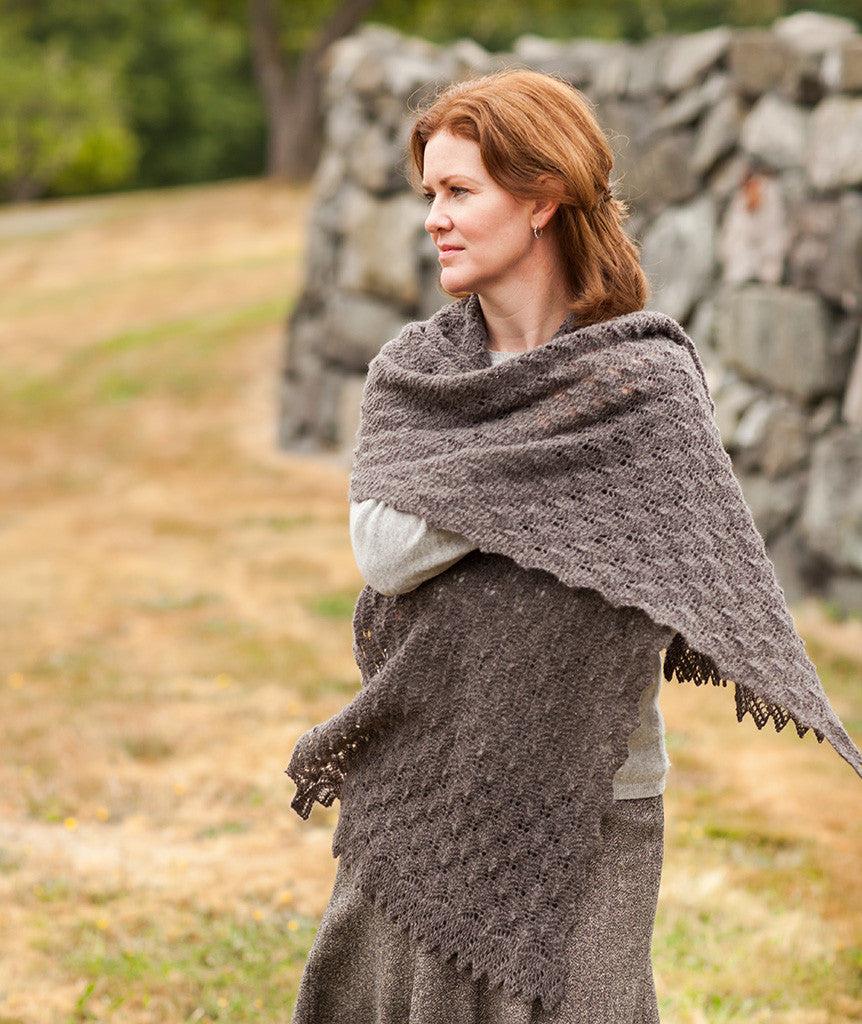
Our rectangular shawl and scarf begin with sideways sawtooth garter-stitch edgings. The length is then knitted in a classic Fir Cone eyelet pattern that’s lacy enough to look pretty and opaque enough to be cozy. Designer Becky ffitch, our lace teacher, was inspired by traditional Shetland lace patterns found in historic stitch dictionaries. We think this is the definition of romantic!
While we were knitting the traditional Shetland edgings for our wrap and scarf, it really got our creative juices flowing. Where else, we wondered, could you use this sweet little strip of knitted lace? Our pattern includes suggestions for experimenting with yarn weights to edge various garments, accessories, all sorts of things. Once you start thinking about edgings, we know you’ll see opportunities for pretty Shetland edgings everywhere you look!
See how we've used this pattern!
The Details
FINISHED SIZE
Finished size
Shawl: Approx. 19 x 80"/48 x 203cm, after blocking.
Scarf: Approx. 7½ x 72"/19 x 183cm, after blocking.
YARN
Shawl: 7 skeins Jamieson's Ultra (210 yds /192m each); shown in Color 102. Or approx. 1470 yds/1345m of an equivalent lace-weight yarn.
Scarf: 2 skeins Isager Spinni Wool 1 (330 yds/302m each); shown in Color 15s. Or approx. 660 yds/604m of lace-weight yarn.
Edging only: Approx. 3–4yds/m of lace-weight yarn per inch of knitted edging; shown in Isager Spinni Wool 1.
NEEDLES & NOTIONS
US 4 (3.5mm) needles, or size to obtain gauge.
Plus spare needle same size or smaller.
4 locking stitch markers.
Darning needle to finish.
Blocking wires and/or T-pins.
GAUGE
Approx. 24 sts = 4"/10cm in Fir Cone lace pattern, after blocking.
KNITTER'S NOTES
The Fir Cone stitch pattern is a multiple of 10 + 5. Each 10-st repeat of the lace pattern is picked up from two repeats of the edging (two points). Thus, to widen the scarf, you must work two additional edging points for each additional 10-st repeat of the pattern.
Because this piece is done in garter stitch, it will be difficult to distinguish the 'right' side from the 'wrong' side. For this reason, put a safety pin or locking marker on the right side—the side on which you pattern (odd numbered rows). That way, when the side with the marker is facing you, you know you are knitting an odd-numbered row.
When blocking, lay the piece out to the correct (or desired) length first, then really stretch it out for width. This is because it will tend to stretch quite a bit lengthwise, so you need to control that, and get as much width as possible. Use pins to pull out the points of the lace edging and the scallops along the side.
For edgings: You can use virtually any weight of smooth, solid-colored yarn for Shetland edgings. Start with a needle a couple of sizes larger than suggested on the ball band, knit a few repeats and block your swatch to see what combinations of yarn and needle you like!
Read description
The Design
“Just the thing for a romp on the moors!”
Our rectangular shawl and scarf begin with sideways sawtooth garter-stitch edgings. The length is then knitted in a classic Fir Cone eyelet pattern that’s lacy enough to look pretty and opaque enough to be cozy. Designer Becky ffitch, our lace teacher, was inspired by traditional Shetland lace patterns found in historic stitch dictionaries. We think this is the definition of romantic!
While we were knitting the traditional Shetland edgings for our wrap and scarf, it really got our creative juices flowing. Where else, we wondered, could you use this sweet little strip of knitted lace? Our pattern includes suggestions for experimenting with yarn weights to edge various garments, accessories, all sorts of things. Once you start thinking about edgings, we know you’ll see opportunities for pretty Shetland edgings everywhere you look!
See how we've used this pattern!
The Details
FINISHED SIZE
Finished size
Shawl: Approx. 19 x 80"/48 x 203cm, after blocking.
Scarf: Approx. 7½ x 72"/19 x 183cm, after blocking.
YARN
Shawl: 7 skeins Jamieson's Ultra (210 yds /192m each); shown in Color 102. Or approx. 1470 yds/1345m of an equivalent lace-weight yarn.
Scarf: 2 skeins Isager Spinni Wool 1 (330 yds/302m each); shown in Color 15s. Or approx. 660 yds/604m of lace-weight yarn.
Edging only: Approx. 3–4yds/m of lace-weight yarn per inch of knitted edging; shown in Isager Spinni Wool 1.
NEEDLES & NOTIONS
US 4 (3.5mm) needles, or size to obtain gauge.
Plus spare needle same size or smaller.
4 locking stitch markers.
Darning needle to finish.
Blocking wires and/or T-pins.
GAUGE
Approx. 24 sts = 4"/10cm in Fir Cone lace pattern, after blocking.
KNITTER'S NOTES
The Fir Cone stitch pattern is a multiple of 10 + 5. Each 10-st repeat of the lace pattern is picked up from two repeats of the edging (two points). Thus, to widen the scarf, you must work two additional edging points for each additional 10-st repeat of the pattern.
Because this piece is done in garter stitch, it will be difficult to distinguish the 'right' side from the 'wrong' side. For this reason, put a safety pin or locking marker on the right side—the side on which you pattern (odd numbered rows). That way, when the side with the marker is facing you, you know you are knitting an odd-numbered row.
When blocking, lay the piece out to the correct (or desired) length first, then really stretch it out for width. This is because it will tend to stretch quite a bit lengthwise, so you need to control that, and get as much width as possible. Use pins to pull out the points of the lace edging and the scallops along the side.
For edgings: You can use virtually any weight of smooth, solid-colored yarn for Shetland edgings. Start with a needle a couple of sizes larger than suggested on the ball band, knit a few repeats and block your swatch to see what combinations of yarn and needle you like!
Pattern options
| Pattern options | Price | Quantity | Total |
|---|---|---|---|
|
Price
Regular price
$9.00
Sale price
$9.00
Regular price
Quantity Total $0.00 |
Regular price
$9.00
Sale price
$9.00
Regular price
|
|
$0.00 |
|
Price
Regular price
$9.00
Sale price
$9.00
Regular price
Quantity Total $0.00 |
Regular price
$9.00
Sale price
$9.00
Regular price
|
|
$0.00 |


Total quantity:
0